

How the Model Code System Works in Canada
October 5, 2021 · 4 min read · Reviewed September 2026
Applies to Anyone building anywhere in Canada. The model codes are national. What has legal force is whatever your province or territory adopted, amended and brought into effect.
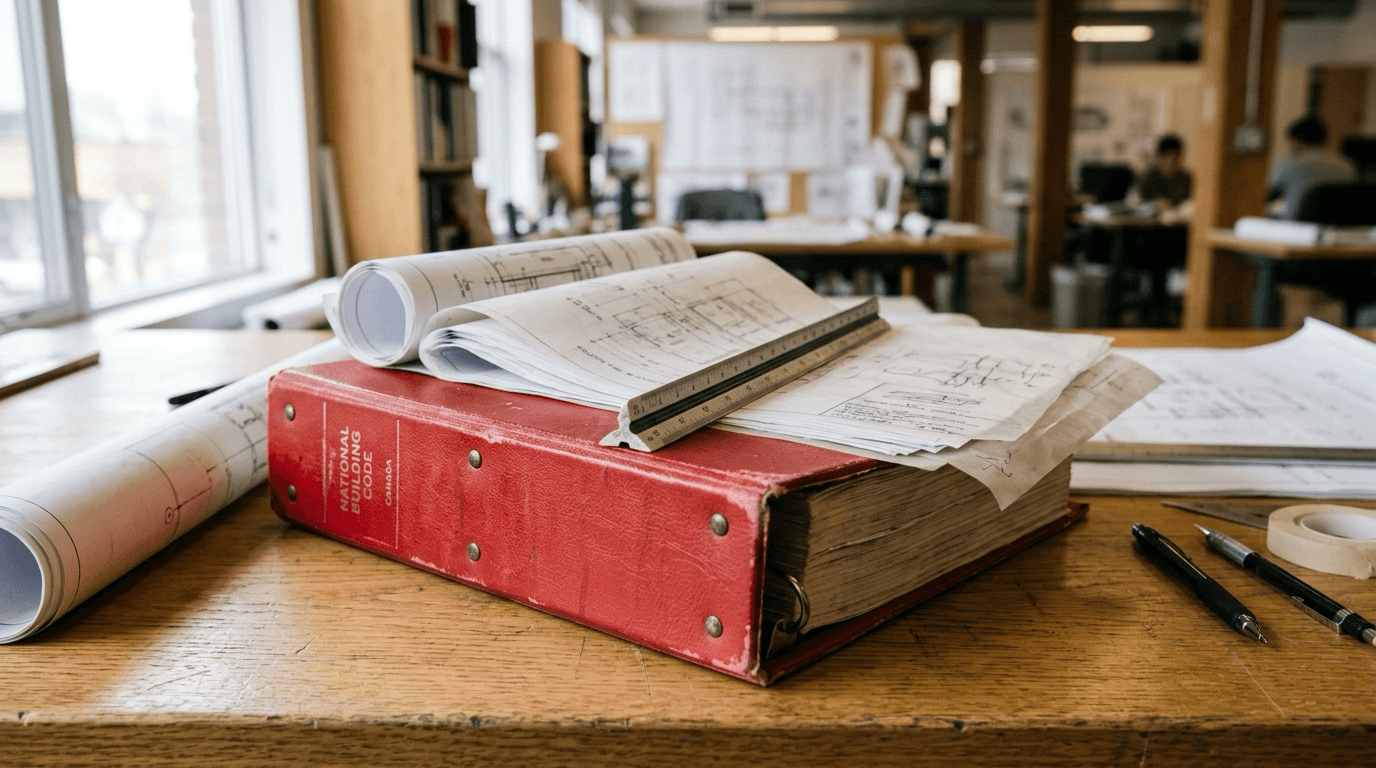
People ask what the Canadian building code says about something, and the honest answer is that there is no such document with legal force. There is a national model code, and then there are thirteen provincial and territorial versions of it, each adopted at a different time and each amended to some degree.
The model codes are developed nationally through a committee process, published as a set, and then offered to the provinces. Adoption is what turns any of it into law, and adoption is a provincial decision.
The documents and what each covers#
| Document | Covers | Where it turns up |
|---|---|---|
| National Building Code | Structure, fire safety, egress, occupancy, most of house construction | The one people mean when they say "the code" |
| National Fire Code | Ongoing safety of buildings in use, storage of hazardous materials | Applies after occupancy, often enforced by a different department |
| National Plumbing Code | Drainage, venting, water supply, fixtures | Usually a separate permit and a separate inspector |
| National Energy Code for Buildings | Envelope and systems efficiency in larger buildings | Houses are generally covered by a section of the building code instead |
| Provincial amendments | Anything the province chose to change | Where the local requirements live |
The electrical code sits outside this family. It is developed separately, adopted separately, and enforced in several provinces by a dedicated electrical authority rather than by the municipality. That is why an electrical permit is often a different application to a different body.
The building code also splits internally. Part 9 covers houses and small buildings and is written prescriptively, so it reads as a list of things to do. Larger and more complex buildings fall under Part 3, which is performance-oriented and assumes a designer. Which part your project falls under changes how much of the code applies and who has to be involved.
Adoption is where the differences come from#
A province can adopt a model code as published, adopt it with a list of amendments, or write its own code that references it. All three happen. Ontario, Quebec and British Columbia maintain their own codes, and the rest adopt the national documents with varying amounts of modification.
Amendments are rarely arbitrary. They usually reflect something local: seismic conditions on the west coast, snow and frost in the north and the prairies, wildfire exposure in the interior, or a policy choice about energy performance. Reading a province’s amendments is a reasonable way to learn what that province worries about.
Timing adds another layer. A new model code edition is published, and provinces adopt it over the following years rather than on a common date. For a period after publication, different parts of the country are legitimately working from different editions.
Which edition applies to your project#
This matters most during a transition, when a province has adopted a new edition with an effective date. The usual rule is that the edition in force when your permit application is made governs the project, not the edition in force when construction starts or finishes.
Ask the building department which edition is in force
One question, and it saves working from the wrong document. They will also tell you whether a transition is under way.
Find out what your province amended
Provincial amendments are published alongside the adopted code. They are where the numbers you were told by someone in another province stop being right.
Check for municipal bylaws on top
Grading, servicing and demolition requirements often sit here rather than in the code.
Note the date your application is accepted
During a changeover this is the date that fixes which edition applies. Submitting a week earlier can matter.
Common questions#
- Is there a single Canadian building code?
- No. There is a national model code with no legal force of its own, and thirteen adopted versions that do. Anyone quoting a national requirement without naming a jurisdiction is giving you a starting point rather than an answer.
- Why is the code not free to read online?
- The model codes are published by the National Research Council and are available to view, but they are copyrighted and licensed rather than open. Provincial codes have their own publishers and their own terms.
- Does a newer edition mean my existing house is now non-compliant?
- No. A building is generally assessed against the code in force when it was built. New editions apply to new work, and renovations can bring parts of a building into scope.
- Who decides what the code means when it is ambiguous?
- The authority having jurisdiction, which in most cases is your municipal building department. Provinces also publish interpretations and bulletins that carry weight.
- What is the difference between Part 9 and Part 3?
- Part 9 covers houses and small buildings and is prescriptive, so it can be followed without a designer. Part 3 covers larger and more complex buildings and expects professional design. Size, height and occupancy decide which applies.
- Do the codes cover everything about a building?
- No. They cover health, safety, accessibility and, increasingly, energy. Whether you may build at all, how large, and where on the lot are zoning questions decided elsewhere.
Confirm the edition and effective date adopted in your municipality — provinces and territories adopt on their own schedule.
Related notes
Ask your own code question
Canadian Codes answers questions like this one from national, provincial, territorial, and municipal sources, and cites the document, section, and page so you can check it yourself.
Try it free →