

Errata: How Codes Get Corrected Between Editions
February 14, 2024 · 4 min read · Reviewed September 2026
Applies to Anyone working from a printed or downloaded code in Canada. Errata are issued by the publisher, and provinces issue their own corrections and bulletins as well.
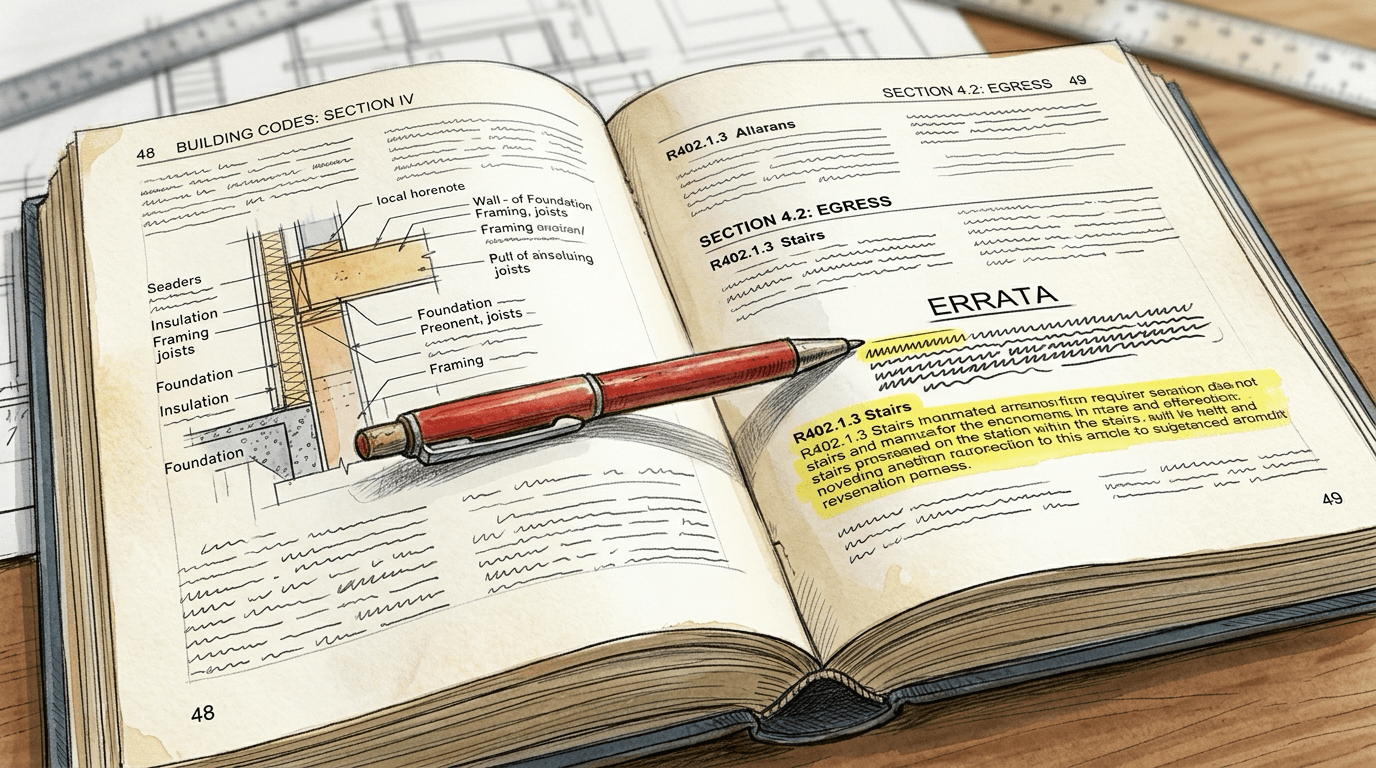
A code is a large technical document assembled by committees over years, and it goes to print with mistakes in it. Wrong cross-references, a table value that does not match the text, a clause that says the opposite of what was intended. This is ordinary for documents of that size.
Most are harmless typographical slips. A few are not. A cross-reference pointing at the wrong clause, or a table figure with a transposed digit, can send a design in the wrong direction with nothing on the page to signal that anything is amiss.
Waiting for the next edition to fix them would mean living with a known error for years, so publishers issue corrections in between. Those are errata, and provinces issue their own alongside interpretation bulletins.
The problem is distribution. A correction published online does nothing for the copy on your desk, and nobody sends you a notice.
The kinds of change between editions#
| Type | What it does | Weight |
|---|---|---|
| Erratum | Corrects an error in the published text | Corrects what the code always meant |
| Revision | Changes a requirement between editions | Changes the requirement, with an effective date |
| Interpretation bulletin | Explains how a provision is applied | Guidance, and departments follow it |
| Provincial amendment | Alters the adopted code | Has legal force where adopted |
| Committee ruling | Answers a specific technical question | Persuasive, and often published |
The distinction that matters most is between an erratum and a revision. An erratum says the text was wrong and this is what it should have said, so it applies to how the provision is read. A revision changes the requirement itself and comes with an effective date, so projects on either side of that date are treated differently.
How you find out#
Usually from someone else. An inspector cites a provision that reads differently from your copy, or a colleague mentions a correction. That works after a fashion, and it is a poor system to rely on when the stake is a design already built.
The better habit is to check the publisher’s errata page and your province’s bulletin page when starting a project, and to note in the file which version you worked from. That second part matters: it lets you explain, later, why a decision was made the way it was.
Provincial bulletins deserve particular attention because they carry weight with building departments and they address exactly the questions that come up on real projects. Several provinces maintain a searchable archive of them.
Industry associations are a useful second channel. They tend to circulate significant corrections to their members faster than anyone reads a publisher’s errata page, and their summaries usually explain the practical consequence rather than only quoting the corrected wording.
Confirm the edition and the amendments in force
Which edition your province adopted, and which provincial amendments came with it.
Check the errata page at project start
Publishers maintain these. It takes minutes and it is the cheapest risk reduction available.
Scan the provincial bulletins
These answer interpretation questions and they tend to cover the provisions people argue about.
Record what you relied on
Note the edition, amendment set and errata date in the project file, so a future question has an answer.
Re-check on long projects
A project running two or three years can outlive the version it started under. Worth a look at each major milestone.
Common questions#
- Should I keep the superseded version?
- Yes, in the project file. If a question arises years later about why something was designed a particular way, the version you relied on is the answer.
- Does the building department track errata for me?
- They generally work from the current text, which is the point. They are not obliged to notice that your drawings were prepared from an older version.
- Does an erratum change what I have to build?
- It changes how the provision reads, and in that sense it can change your design. It is presented as a correction of the published text rather than as a new requirement.
- What if I built from the uncorrected text?
- Talk to the building department. Outcomes vary with how significant the error was and how far the work has gone, and they will have seen it before.
- Are provincial and national errata the same?
- No. Provinces that publish their own code issue their own corrections, and provinces that adopt the national one may issue guidance on top. Check both where both apply.
- Do I need the paid online version?
- Not necessarily, and the advantage of a maintained online edition is that corrections are already in it. If you work from a static copy, the errata check is doing that job manually.
- How often are errata issued?
- Irregularly. They appear as errors are identified and confirmed, which means there is no schedule to rely on and no substitute for checking.
- Who decides an error is an error?
- The committee responsible for the provision, through the publisher. Individual departments do not issue errata, though they do issue interpretations.
Confirm the edition and effective date adopted in your municipality — provinces and territories adopt on their own schedule.
Related notes
Ask your own code question
Canadian Codes answers questions like this one from national, provincial, territorial, and municipal sources, and cites the document, section, and page so you can check it yourself.
Try it free →