

Why Requirements Change at the City Limit
November 15, 2023 · 4 min read · Reviewed September 2026
Applies to Projects anywhere in Canada. What a municipality may impose, and through which instrument, is set by provincial legislation and differs between provinces.
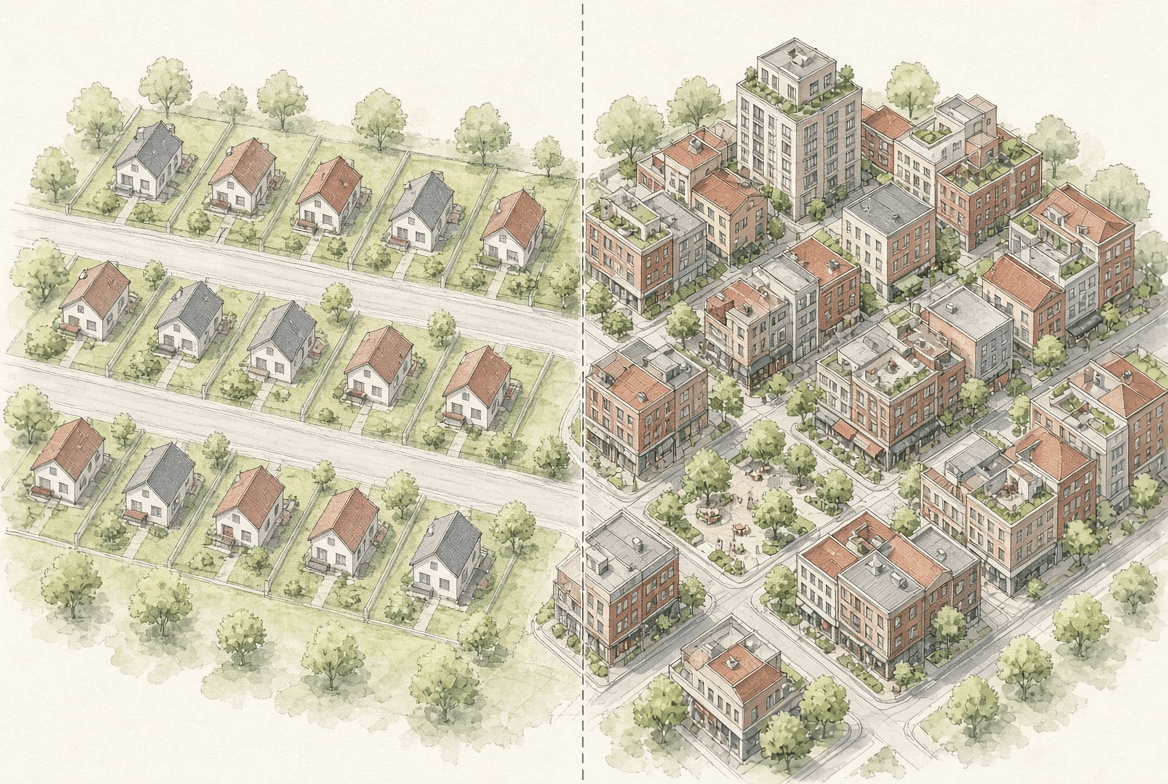
Two contractors compare notes across a municipal boundary and find they are being asked for different things. The usual conclusion is that one city amended the building code. Almost always it did not.
Building codes are provincial instruments. A municipality administers and enforces the code; it does not get to rewrite the technical requirements. What it can do is impose requirements through other instruments, and there are several.
The practical effect is the same for you. Something is required here and not there. But knowing which instrument it comes from tells you who to ask and whether relief is even possible.
Where local differences come from#
| Instrument | What it controls | Example |
|---|---|---|
| Zoning bylaw | Use, height, setbacks, coverage, parking | Whether a secondary suite is permitted |
| Servicing standards | Connections to municipal systems | Backwater valves, sewer connection details |
| Lot grading and drainage | Where water goes on and off the lot | A grading plan and a deposit before permit |
| Development requirements | Contributions, studies, agreements | Tree protection, stormwater management |
| Property standards | Maintenance of existing buildings | Enforced against existing housing, not new work |
| Fire department requirements | Access, hydrants, on-site provisions | Route width and turning for apparatus |
| Local interpretation | How ambiguous provisions are applied | What counts as a substantial alteration |
Servicing standards are the ones people run into most and expect least. How you connect to municipal water and sewer, whether a backwater valve is required, what a grading plan has to show, and what deposit you post are all local and all capable of surprising a project priced from experience elsewhere.
Development requirements are the other reliable surprise, and they scale with the project. A single house may trigger nothing beyond a grading deposit. A small infill development can attract stormwater management, tree protection, a servicing agreement and contributions, each with its own study and its own reviewer.
Why the differences exist#
Most local requirements trace back to something the municipality has had to deal with. A city that has flooded imposes backwater valves and stricter grading. One with a history of interface fires adds requirements around vegetation and cladding. A community on well and septic has requirements a serviced city never thinks about.
Capacity is another driver. A municipality whose sewer system is at its limit will impose stormwater controls that a neighbouring one with spare capacity does not need. Those are engineering decisions rather than policy preferences.
Interpretation accounts for a real share of the remainder. Where a code provision requires judgement, two departments can land in different places, and both are within their authority. That is not inconsistency so much as the system working as designed.
Working across municipal boundaries#
Treat every municipality as new
Experience in one is a starting point rather than an answer. The building code travels; the rest does not.
Ask for the residential application package
Most departments publish one, and it collects the local requirements in a single document. Reading it takes an hour.
Ask specifically about servicing and grading
These are the requirements most likely to be missing from a budget built elsewhere, and they carry deposits and inspections of their own.
Check whether the fire department reviews
On some projects they do, with their own comments and their own timeline, which is easy to leave out of a schedule.
Get local interpretations in writing
On anything requiring judgement, a written answer is what protects you when the file changes hands.
Common questions#
- Can a municipality require more than the building code?
- Not usually through the code itself, and frequently through other instruments. The result on your project is the same, so the distinction matters mainly for knowing who to ask.
- Why does the inspector here want something the last one did not?
- It can be a local bylaw, a servicing standard, or a difference in interpretation. Asking which of the three, and for the reference, usually settles it quickly.
- Is there one place to find all the local requirements?
- Rarely. The application package is the closest thing. Zoning, engineering standards and fire requirements often live in separate documents in separate departments.
- Do these rules apply outside municipal boundaries?
- Unorganised or unincorporated areas are usually administered provincially or by a regional body, and the requirements differ again. Do not assume rural means unregulated.
- Can I appeal a local requirement?
- It depends on the instrument. Zoning has a variance process. Servicing standards are engineering requirements with much less room. Code interpretations have their own escalation path.
- Why do fees differ so much?
- Fee schedules are set locally and often calculated differently, some on construction value and some on floor area. Compare the schedule rather than a remembered total.
Related notes
Ask your own code question
Canadian Codes answers questions like this one from national, provincial, territorial, and municipal sources, and cites the document, section, and page so you can check it yourself.
Try it free →