

What Attic Ventilation Is For
December 14, 2022 · 4 min read · Reviewed September 2026
Applies to Vented attics on houses in Canada. Required vent area and the split between high and low vents come from your provincial code. Unvented and cathedral assemblies follow different rules.
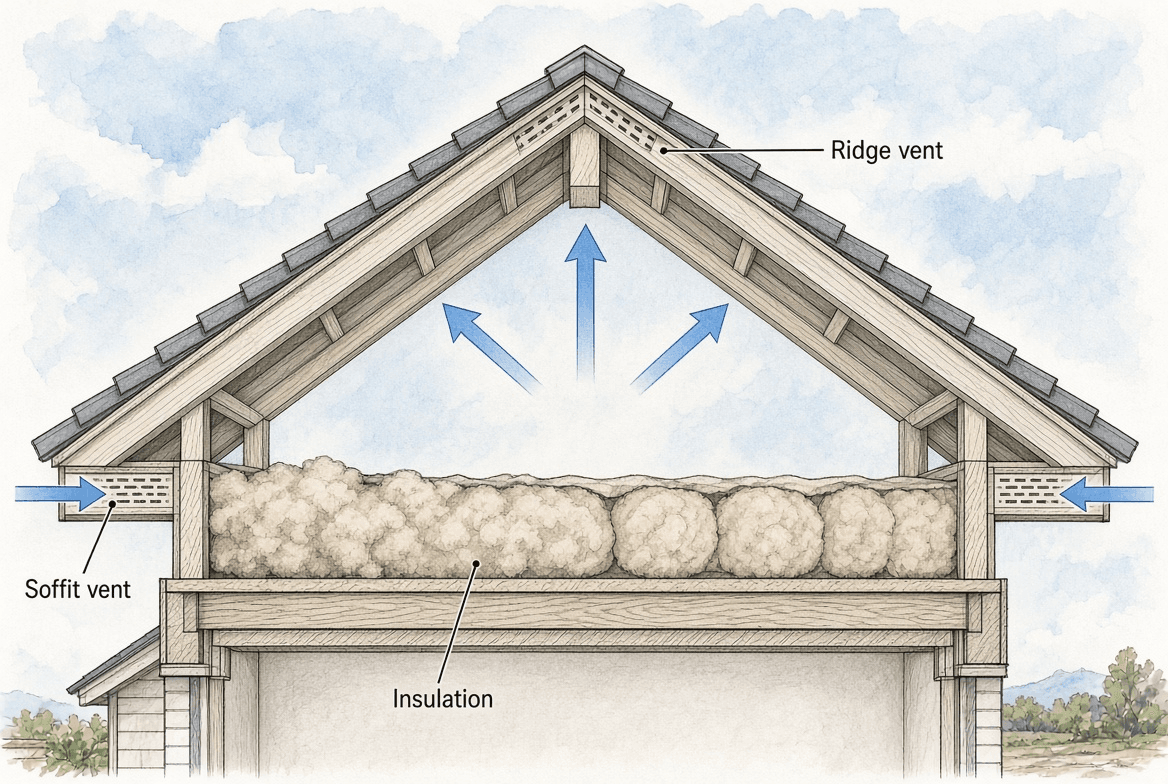
A vented attic works by staying close to outdoor temperature. Cold outdoor air enters low at the soffits, warms slightly, picks up moisture, and leaves high at the ridge. That flow does two jobs: it keeps the roof deck cold in winter, and it removes water vapour before it condenses on the underside of the sheathing.
Both jobs depend on the ceiling below being reasonably airtight. Ventilation is there to handle the small amount of moisture that gets through. It was never designed to handle a ceiling full of holes.
Ice dams are a heat problem#
An ice dam forms when snow melts on the upper roof and refreezes at the cold eave. The melting happens because heat is getting into the attic and warming the deck. More vents help by carrying that heat away, but they are treating the symptom.
The heat is arriving through gaps in the ceiling and through insulation that is thin or displaced. Attic hatches, bathroom fans, pot lights, the tops of interior partitions and plumbing stacks are the usual routes. Sealing those and getting full insulation coverage does more than any vent arrangement.
How ventilation stops working#
| Problem | What causes it | Effect |
|---|---|---|
| Blocked soffits | Insulation pushed into the eave during a top-up | No low intake, so the ridge vent pulls from inside the house |
| No baffles | Nothing holding the vent path open above the insulation | The path closes as insulation settles |
| Too much high vent, too little low | Ridge vents added without matching soffit intake | The attic draws air from the living space through ceiling gaps |
| Mixed vent types | Ridge, gable and box vents all on one attic | Short-circuits the flow so part of the attic never ventilates |
| Sealed or painted soffits | Renovation or new cladding covering the intake | Intake disappears without anyone noticing |
The intake-versus-exhaust balance is the one that surprises people. Adding a ridge vent to an attic with blocked soffits does not improve ventilation. It makes the attic better at pulling conditioned air up through every gap in the ceiling, which brings more moisture with it.
Not every roof is vented#
Unvented assemblies are a legitimate approach, common on cathedral ceilings and complex roof shapes where a clear vent path is impossible. They work by keeping the roof deck warm enough never to reach the dew point, usually with insulation applied directly to the underside of the sheathing.
The eave is where the two jobs collide#
Ventilation wants a clear air path at the eave. Insulation wants full depth all the way out to the exterior wall. In a standard truss those two wants meet in a space a few inches tall, and one of them usually loses.
When insulation wins, the soffit blocks and the attic stops ventilating. When ventilation wins, the insulation thins out exactly above the wall plate, which is the coldest part of the ceiling and the place ice dams start. Neither outcome is good and the compromise is usually made by whoever is holding the blower hose.
Baffles solve half of it by holding the vent path open. Getting full insulation depth over the plate is the other half, and on a new build it is solved at the truss: a raised heel truss gives you the height to do both. On an existing house it is a harder problem, which is why the eave is worth looking at specifically rather than assuming a top-up fixed it.
Common questions#
- I have frost on my attic sheathing. More vents?
- Look at the ceiling first. Frost means moist indoor air is reaching the attic, and the fastest fix is finding where it gets in. Check the bathroom fan duct, the attic hatch and any pot lights before adding vents.
- Should I mix ridge vents and gable vents?
- Generally no. They tend to short-circuit each other, with the ridge drawing from the gable rather than from the soffits, so part of the attic gets no flow.
- Do I need baffles if the insulation is not near the soffit?
- Install them anyway. Insulation settles and gets topped up by someone who does not know the eave has to stay clear. Baffles keep the path open permanently.
- Does a powered attic fan help?
- Often the opposite. A powered fan can depressurise the attic enough to pull conditioned air out of the house through ceiling gaps, which raises your bills and moves more moisture upward.
- How much ventilation do I need?
- It is a ratio of vent area to insulated ceiling area, with a required split between high and low. Your provincial code sets both. The split is the part people get wrong.
Looking for the number?
These pages state the requirement and name the document it comes from.
Related notes
Ask your own code question
Canadian Codes answers questions like this one from national, provincial, territorial, and municipal sources, and cites the document, section, and page so you can check it yourself.
Try it free →