

What Fails an Electrical Rough-In
March 13, 2024 · 4 min read · Reviewed September 2026
Applies to Electrical work in Canada, under the Canadian Electrical Code as adopted and amended provincially. In several provinces the inspecting body is a separate electrical authority.
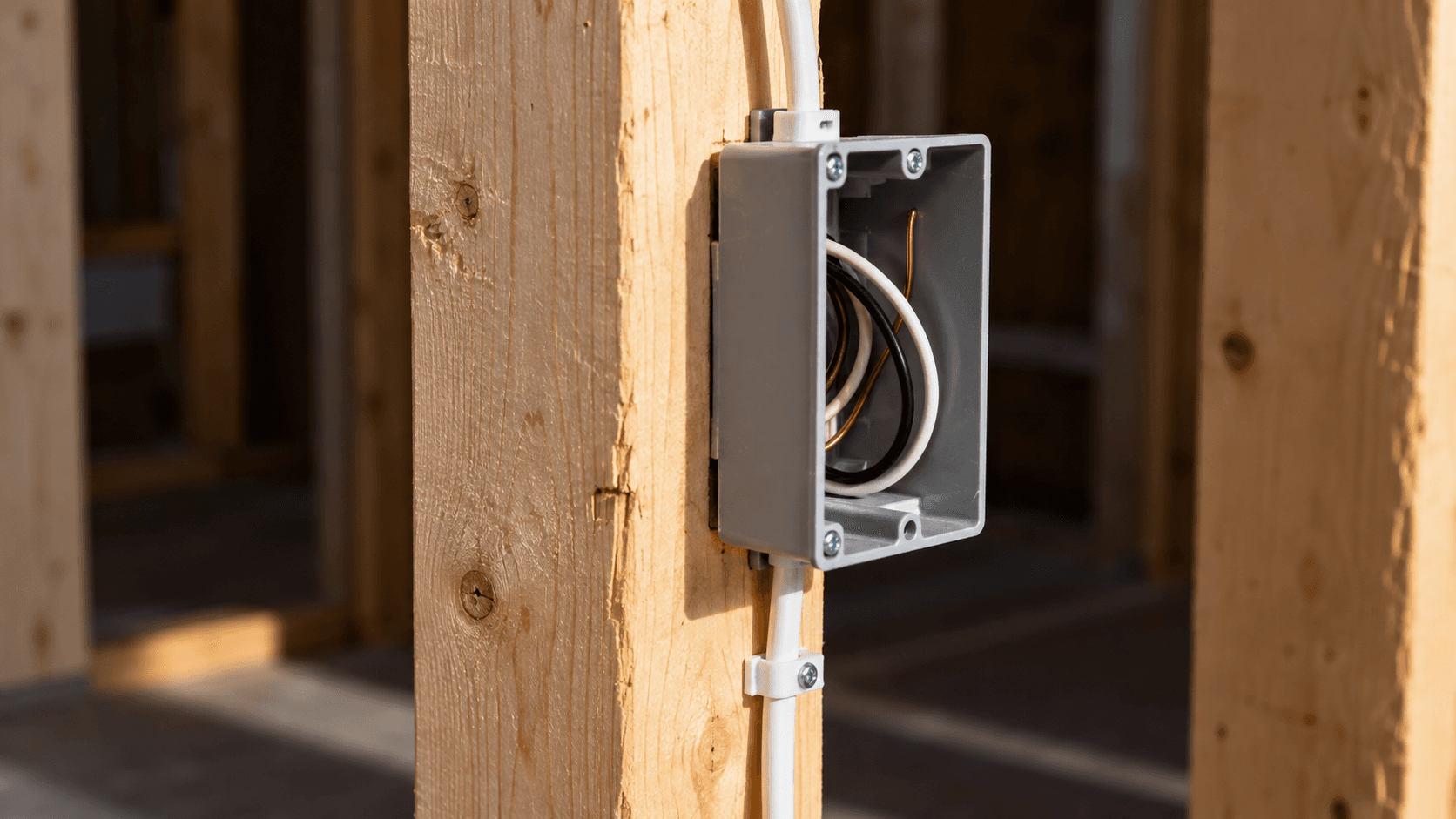
Electrical rough-in is inspected at the one moment everything is exposed: boxes mounted, cable run and stapled, conductors left long, nothing terminated and nothing covered. After drywall, an inspector can see the cover plates and very little else.
The failures repeat across jobs and provinces, and they cluster into a handful of categories. None of them are exotic and all of them are quick to correct at this stage.
One thing to settle before you start: in several provinces electrical is a separate permit from a separate authority, with its own inspector and its own schedule. Coordinating it with the framing and insulation inspections is your job rather than theirs.
The repeat offenders#
| Failure | What it looks like | Why it matters |
|---|---|---|
| Box fill exceeded | Too many conductors and devices in one box | Heat and damaged insulation when it is crowded shut |
| Staples too tight | Cable sheath pinched or deformed | Damages the sheath and can nick a conductor |
| Support spacing | Cable unsupported over long runs or near boxes | Strain lands on the terminations |
| No mechanical protection | Cable through a stud closer than allowed to the face | A drywall screw finds it later |
| Boxes set wrong | Not flush with the finished surface | Fails when the finish thickness is added |
| Conductors too short | Not enough length left to terminate | Every device becomes awkward and unreliable |
| Missing bonding | Grounds not made up, boxes not bonded | Straightforward safety failure |
| Cable through the wrong space | Run through ducts or plumbing chases | Restricted, and creates other hazards |
| Unsecured boxes | Nailed lightly or loose on the stud | Moves when devices are installed |
Box fill and staples account for a large share on their own. Box fill is a calculation, not a judgement, and it counts conductors, devices, clamps and grounds. Once you know it is a calculation, the fix is choosing a deeper box before running the cable rather than fighting it at termination.
Mechanical protection and holes#
Cable passing through framing has to be far enough back from the face that a fastener will not reach it, and where it cannot be, a protective plate goes over the stud. This is the failure with the longest tail, because the consequence appears years later when someone hangs a shelf.
Holes in framing have their own limits on size and position, set by the structural side rather than the electrical one. A run that solves an electrical problem by drilling through the middle of a joist can create a framing failure instead, and both inspectors will look at it.
Notching is generally worse than drilling, because a notch removes material from the edge where the stress is highest. Where a notch is unavoidable, it usually needs a plate over it for the same reason cable does.
Preparing for the inspection#
Leave everything visible
No insulation, no vapour barrier, nothing covered. Anything an inspector cannot see is something they cannot pass.
Make up the grounds
Bonding made up in every box is a fast thing to check and a common thing to find missing.
Walk the runs looking at sheath
Check for pinched staples, scuffs from the drill and anything the framing crew put a screw through.
Count the busy boxes
The three-gang by the door and the box where two circuits meet are where fill goes over. Check those rather than every box.
Confirm the other trades are not in your way
Plumbing and mechanical share the same stud bays. A duct installed after your rough-in can bury a run you need visible.
Common questions#
- Can I do my own electrical work?
- In many provinces a homeowner may do work on their own home under a permit, and in some the work is restricted to licensed contractors. Check your province, because the answer genuinely differs.
- What happens if it fails?
- You get a list, you fix it, and you book a reinspection. Usually not a disaster on schedule unless it means other trades have to wait.
- Do I need arc-fault protection everywhere?
- Requirements have broadened over successive code editions and the specifics depend on the edition your province adopted. Ask rather than assuming the rule from a job a few years ago still holds.
- Is the electrical permit part of the building permit?
- Frequently not. In several provinces it is issued by a separate electrical safety authority with its own inspectors, fees and booking system.
- Can the inspector look at work that is already covered?
- They can ask for it to be uncovered. Covering work before its inspection is the situation to avoid, because the cost of exposing it falls on you.
- How long does an inspection take?
- A house rough-in is usually quick, often under an hour. The lead time to get one booked is the part that affects your schedule.
Related notes
Ask your own code question
Canadian Codes answers questions like this one from national, provincial, territorial, and municipal sources, and cites the document, section, and page so you can check it yourself.
Try it free →