

Getting Foundations In Before the Ground Freezes
August 21, 2025 · 4 min read · Reviewed September 2026
Applies to Construction in cold-climate parts of Canada. Cold-weather concrete requirements and inspection lead times are set locally.
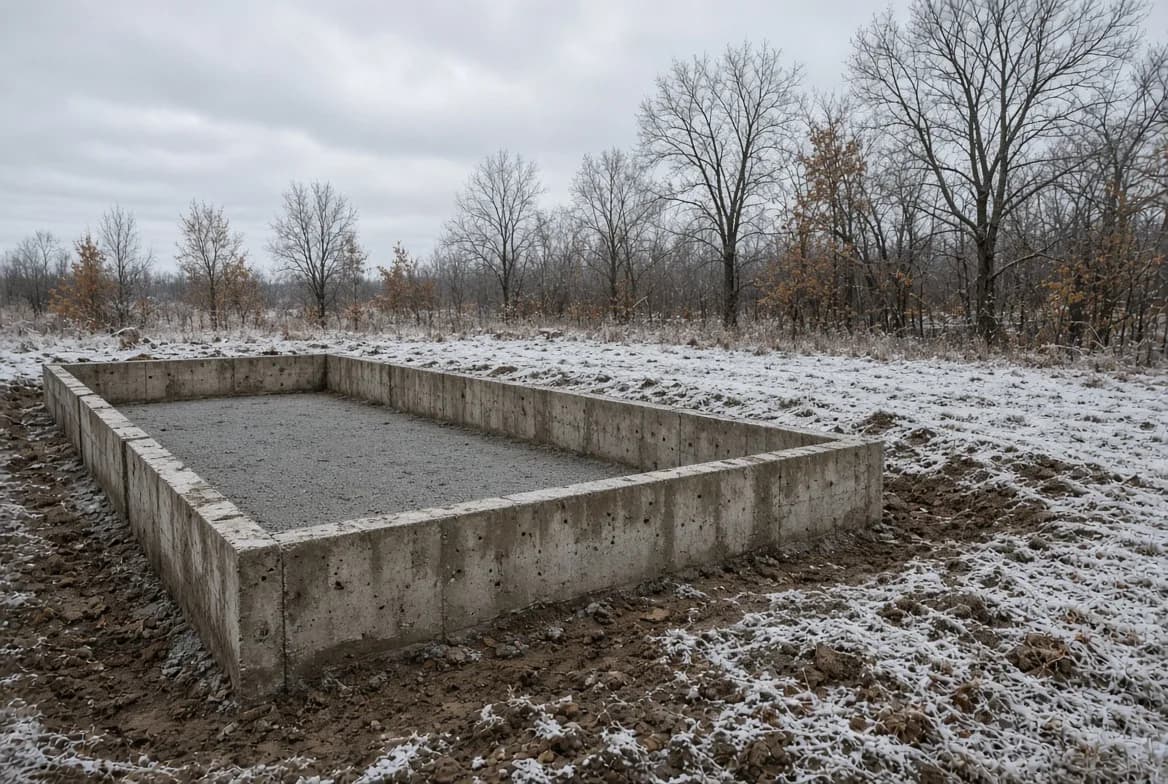
Every year the same thing happens. A project running a few weeks behind in September is running a season behind by November, because the work that has to happen outside stops being possible and the inspections that gate it are backed up.
The frustrating part is that the deadline is not negotiable. A department can add staff to a queue. Nobody can add a week to the ground before it freezes.
What freezing stops#
| Work | What cold does to it | Options |
|---|---|---|
| Excavation | Frozen ground needs breaking rather than digging | Ground blankets, or excavate before the freeze |
| Footings and foundations | Concrete cannot be placed on frozen subgrade | Hoarding, heat, insulated blankets, cold-weather mix |
| Backfill | Frozen lumps do not compact | Stockpile and protect fill, or wait |
| Site grading | Cannot be finished or inspected | Usually deferred to spring by agreement |
| Underground services | Trenching in frozen ground is slow and expensive | Get them in before the freeze |
| Exterior concrete flatwork | Curing and finishing are compromised | Generally postponed |
| Landscaping | Not possible | Deferred, often with a deposit held |
Concrete can be placed in cold weather with the right measures, and those measures cost money and time. Hoarding, heaters, heated mix, insulated blankets and extended curing all add up, and the subgrade still has to be unfrozen when the concrete goes down.
Curing is the part that gets underestimated. Concrete gains strength slowly in the cold, so forms stay on longer and the next stage waits. A pour that would carry load in a week in July can need considerably longer in November, and rushing it produces concrete that never reaches its design strength.
Protection has to continue after the pour as well. Concrete that freezes in its first days is permanently damaged, so the blankets and the heat are a commitment for the following week rather than for the afternoon.
The queue is worst exactly when you need it#
Everyone is chasing the same season, so autumn is when inspection demand peaks. Lead times that were two days in June become a week or more in October, and a failed inspection means going back into that queue rather than a same-day recheck.
That changes how much a failure costs. In summer, a deficiency is a day. In late autumn it can be the difference between pouring this year and not, which is the argument for checking your own work carefully before booking rather than using the inspector as the check.
Work backwards from the freeze, not forwards from today
Put the last realistic date for excavation and concrete on the schedule first, then work back through the inspections that have to happen before it.
Ask the department for current lead times
They know what their queue looks like and it changes through the season. Planning on summer turnaround in October is how schedules fail.
Book early and cancel if needed
Most departments would rather have a cancellation than a last-minute request. Holding a slot costs nothing and protects the date.
Pre-check everything before the inspector arrives
A failure in October costs a week rather than a day. Walk the work yourself first.
Agree deferrals in advance
Grading and landscaping are commonly deferred to spring with a deposit. Arrange it deliberately rather than discovering it at occupancy.
Common questions#
- Does frost in the trench mean starting over?
- Not necessarily. A thin surface frost can often be removed and the subgrade protected. Ground frozen to depth under a footing is a different problem and it has to be dealt with before concrete goes down.
- Can concrete be poured in winter?
- Yes, with cold-weather measures: protected subgrade, appropriate mix, heat and insulation, and extended curing. It costs more and it works.
- What happens if I backfill with frozen material?
- It does not compact, and it settles when it thaws. That produces a depression against the foundation that channels water exactly where you least want it.
- Will the department defer grading to spring?
- Commonly yes, often with a deposit or a condition on occupancy. Arrange it rather than assuming, because the terms vary.
- How much lead time should I allow in autumn?
- Ask locally, and expect it to be longer than summer. Booking ahead and cancelling is the practical hedge.
- Can I leave an excavation open over winter?
- It needs protecting from freeze-thaw, water and collapse, and it may need fencing. It is manageable and it is not free.
- Does frost affect the footing depth requirement?
- The required depth does not change with the season. What changes is how hard it is to reach and to keep the subgrade unfrozen until the pour.
Looking for the number?
These pages state the requirement and name the document it comes from.
Related notes
Ask your own code question
Canadian Codes answers questions like this one from national, provincial, territorial, and municipal sources, and cites the document, section, and page so you can check it yourself.
Try it free →