

Why Handrails Fail Inspection
September 20, 2023 · 4 min read · Reviewed September 2026
Applies to Stairs in houses and other buildings in Canada. Profile limits, height and continuity requirements come from your provincial code, and requirements are stricter outside houses.
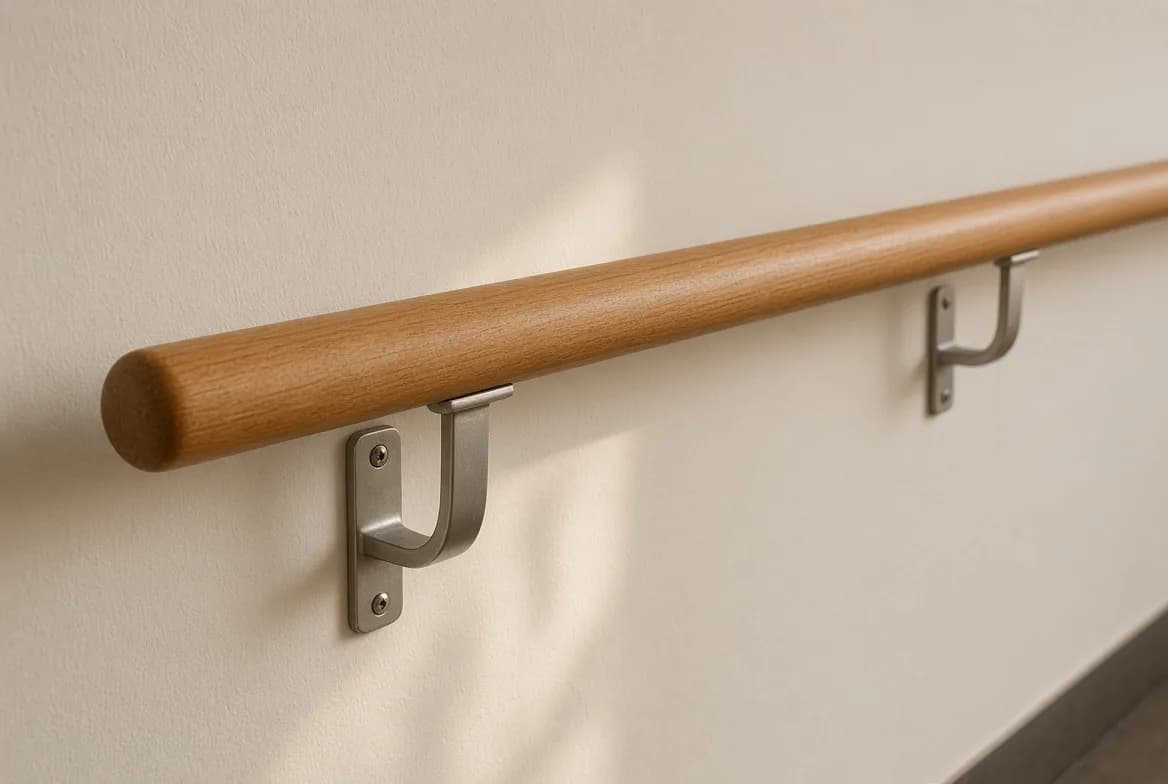
Guards and handrails get conflated constantly. A guard stops you falling off the side of something. A handrail is what you hold while walking down, and what you grab when your foot goes out from under you. A stair often needs both, and they are checked against different rules.
The reason handrails have shape requirements is that scenario: someone is falling, their grip has to arrest it, and a hand can only do that if it can close around the rail. A surface you can rest a palm on does not stop a fall.
That is why the requirement is written about the profile rather than the material or the appearance, and why a beautifully made rail can be rejected on site.
What graspable means#
Codes generally describe a permitted range of dimensions for circular sections, and allow other shapes if they provide an equivalent grip, often via a finger recess in the underside. The detail varies by province, so the profile is worth confirming before an expensive rail is milled.
| What is checked | Why | Common failure |
|---|---|---|
| Cross-section size | A hand has to close around it | A wide feature rail that reads as a shelf |
| Shape | Grip has to resist a downward pull | Square profiles with sharp arrises |
| Clearance to the wall | Fingers need room behind the rail | Brackets mounted tight to a thick trim board |
| Height above the nosings | Comfortable and consistent to hold | Measured from the tread rather than the nosing line |
| Continuity | The hand should not have to let go | Newel posts interrupting the run |
| Ends | A projecting end catches clothing and bags | Rails stopped square instead of returned to the wall |
| Fixing strength | It has to hold a falling adult | Brackets into drywall with no blocking behind |
Continuity and the ends#
The intent is that a hand can travel the whole flight without letting go, which is why rails are generally required to be continuous and why interruptions at newel posts get flagged. Where a rail has to break, the break has its own rules.
Ends matter for a reason that sounds trivial until it happens. A rail that stops in mid-air with an exposed end catches a sleeve, a bag strap or a pocket, which is a fall hazard on a stair. Returning the end into the wall or down to a post removes it.
Requirements are usually stricter outside houses. Public stairs commonly need rails on both sides, extensions past the top and bottom risers, and specific end treatments. A detail acceptable in a house is not automatically acceptable in a small commercial fit-out.
Choosing a rail that will pass#
Confirm the permitted profile locally
Ask the building department, or find the provision in your provincial code, before ordering or milling anything.
Test it with your hand
Close your fist around a sample. If your fingers and thumb do not meet or come close, an inspector will reach the same conclusion faster than you will.
Check the bracket clearance
Fingers need room between rail and wall. Thick trim, panelling or tile added later can eat that clearance after the rail passed.
Plan the ends before installing
Returns to the wall or to a post, and any required extensions, change the length you order.
Confirm the blocking is where you need it
If the wall is already closed, find the studs and plan bracket positions around them rather than hoping.
Common questions#
- My stair has a guard. Do I still need a handrail?
- Usually yes. They do different jobs, and a guard rarely has a graspable profile. On many stairs both are required.
- Does a short flight need one?
- There is generally a threshold in number of risers below which no handrail is required. It is low, and it varies, so confirm rather than assume a few steps are exempt.
- Can I use a rope or a cable?
- No. It has to be rigid enough to arrest a fall, which flexible materials are not.
- What about a rail on only one side?
- Common and often acceptable in houses. Wider stairs and non-residential stairs frequently require both sides.
- Do exterior stairs follow the same rules?
- Broadly yes, and deck stairs are where this is missed most. The guard gets built and the graspable handrail gets forgotten.
- Can I add a rail to an old stair that never had one?
- Yes, and it is a worthwhile retrofit. The constraint is usually finding solid backing in an old wall, which sometimes means opening a strip of plaster.
Looking for the number?
These pages state the requirement and name the document it comes from.
Related notes
Ask your own code question
Canadian Codes answers questions like this one from national, provincial, territorial, and municipal sources, and cites the document, section, and page so you can check it yourself.
Try it free →