

Snow Load: Why the Number Changes Town to Town
January 12, 2022 · 4 min read · Reviewed September 2026
Applies to Anyone building, adding to, or altering a roof in Canada. Design snow loads are tabulated by location, and provinces publish their own tables, so the number is looked up rather than estimated.
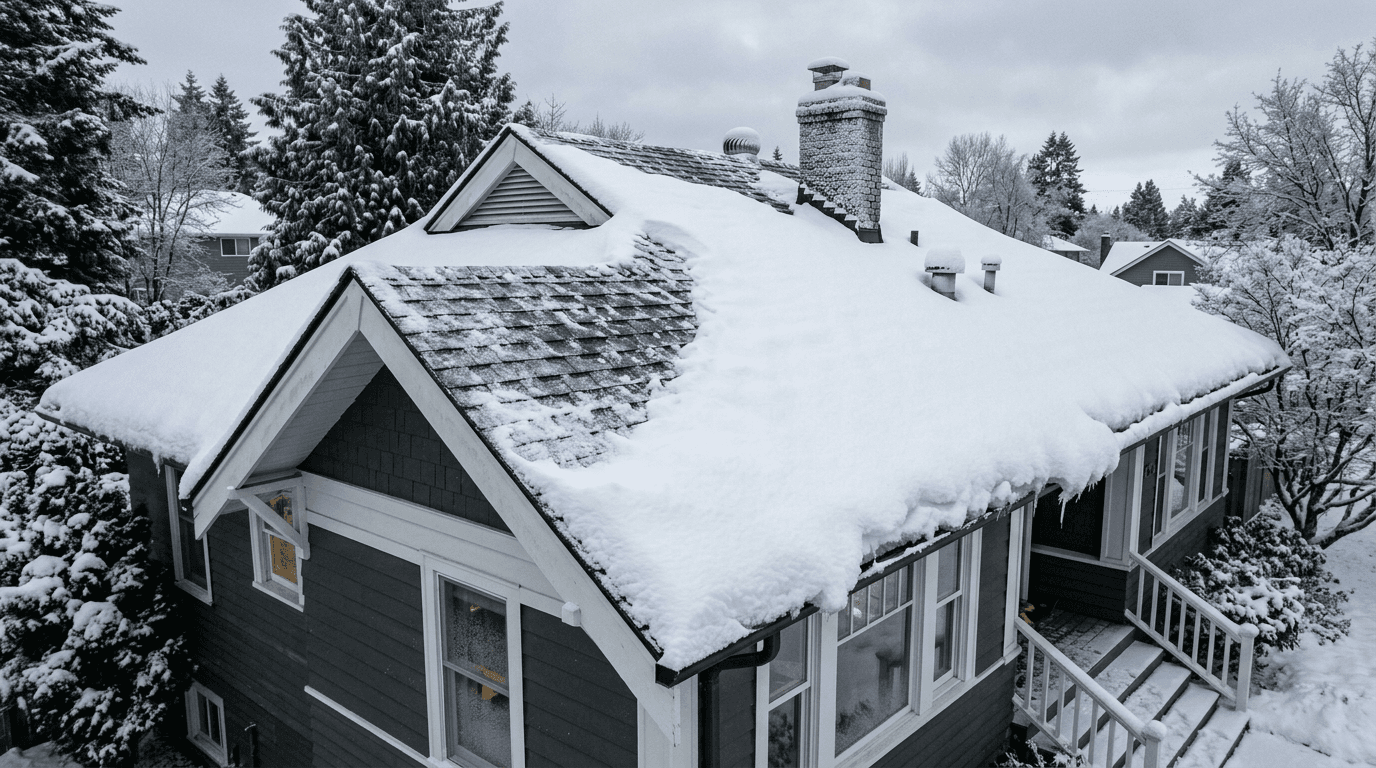
Two houses can be built to the same drawings, one in Halifax and one in Calgary, and need different roof framing. Snow load is one of the few structural inputs that changes with the map, and it changes more sharply than people expect. Neighbouring communities can have different numbers.
The figure comes out of a table. It is based on decades of measurements at or near that location, adjusted for elevation and local conditions. Nobody derives it on site and nobody should be estimating it from what last winter looked like.
Ground snow and roof snow are different numbers#
The tabulated value describes snow on the ground. What sits on a roof is different, usually less on an open slope because wind removes some of it and the roof loses heat. The calculation moves from one to the other with factors for exposure, shape, slope and thermal condition.
A steep slippery roof in an exposed field sheds most of what lands on it. A low-slope roof in a sheltered spot between mature trees holds nearly all of it. Same town, same table value, very different loads on the framing.
Rain matters too. Late-season rain falling onto a saturated snowpack adds weight quickly, and it is the combination rather than snow alone that produces most winter roof failures.
Drifting is what breaks roofs#
A uniform blanket of snow is the easy case. Roofs rarely see one. Wind moves snow off open surfaces and deposits it against anything that interrupts the flow, and the resulting pile can be several times the uniform depth in a narrow band.
| Where snow concentrates | What causes it | Why it matters |
|---|---|---|
| Against a taller wall | Wind drops its load in the lee of the obstruction | Common at additions and two-storey sections |
| Valleys | Two slopes converge and snow collects | Also where meltwater runs and ice dams start |
| Below a steeper roof | Snow slides off the upper roof onto the lower one | The lower roof gets its own load plus the delivery |
| Behind dormers and parapets | Anything projecting creates a drift shadow | Small features can create large local loads |
| Around mechanical units | Same drift mechanism at a smaller scale | Easy to add later without anyone rechecking the roof |
When to clear a roof#
Roofs are designed to carry the snow the table says they will get, so a normal winter is not a reason to climb up. The situations worth watching are the ones the design assumed would not happen at once: a deep pack followed by rain, drifts building against a wall, or a season well beyond normal for the area.
Changing a roof that already exists#
Snow load usually comes up on new construction, but the renovations that touch it are common and easy to overlook. Removing an interior wall that turned out to be carrying part of the roof, adding a dormer, converting an attic, or building anything that changes the roof shape all change how snow sits and how the load travels down.
Re-roofing is generally neutral unless the new covering is heavier than the old one or the sheathing is being changed. Going from asphalt to tile or slate is the case to check, since it adds permanent dead load on top of whatever snow arrives.
Common questions#
- Where do I find the number for my town?
- The tables are published with the code that applies where you are, listed by community. Your building department can confirm which value applies at your address, and elevation can shift it within one municipality.
- Do snow guards help?
- They stop snow sliding off in a sheet, which protects what is below. They also keep the load on the roof rather than shedding it, so they are a trade rather than a pure improvement.
- Does a steeper roof always carry less?
- Generally, above a certain slope and with a slippery surface. But steep roofs shed onto whatever is below them, so the load moves rather than disappearing.
- Can I put solar panels on an existing roof?
- Often, but it needs checking. Panels add weight, change how snow slides, and create new places for drifts to form. That combination is what the structural review is looking at.
- My roof has been fine for forty years. Is that evidence?
- It is evidence about the winters it has seen, not about the design event. Design loads are set for a return period longer than most people own a house.
- Does an unheated garage need more?
- It can. A heated building loses heat through the roof and melts some of the snow. An unheated one does not, so the same roof in the same town can be designed for a higher load.
Looking for the number?
These pages state the requirement and name the document it comes from.
Related notes
Ask your own code question
Canadian Codes answers questions like this one from national, provincial, territorial, and municipal sources, and cites the document, section, and page so you can check it yourself.
Try it free →