

Vapour Barrier vs. Air Barrier
May 10, 2022 · 4 min read · Reviewed September 2026
Applies to Wall, roof and basement assemblies in Canada. Where each layer belongs depends on your climate zone, and below-grade assemblies follow different logic from above-grade ones.
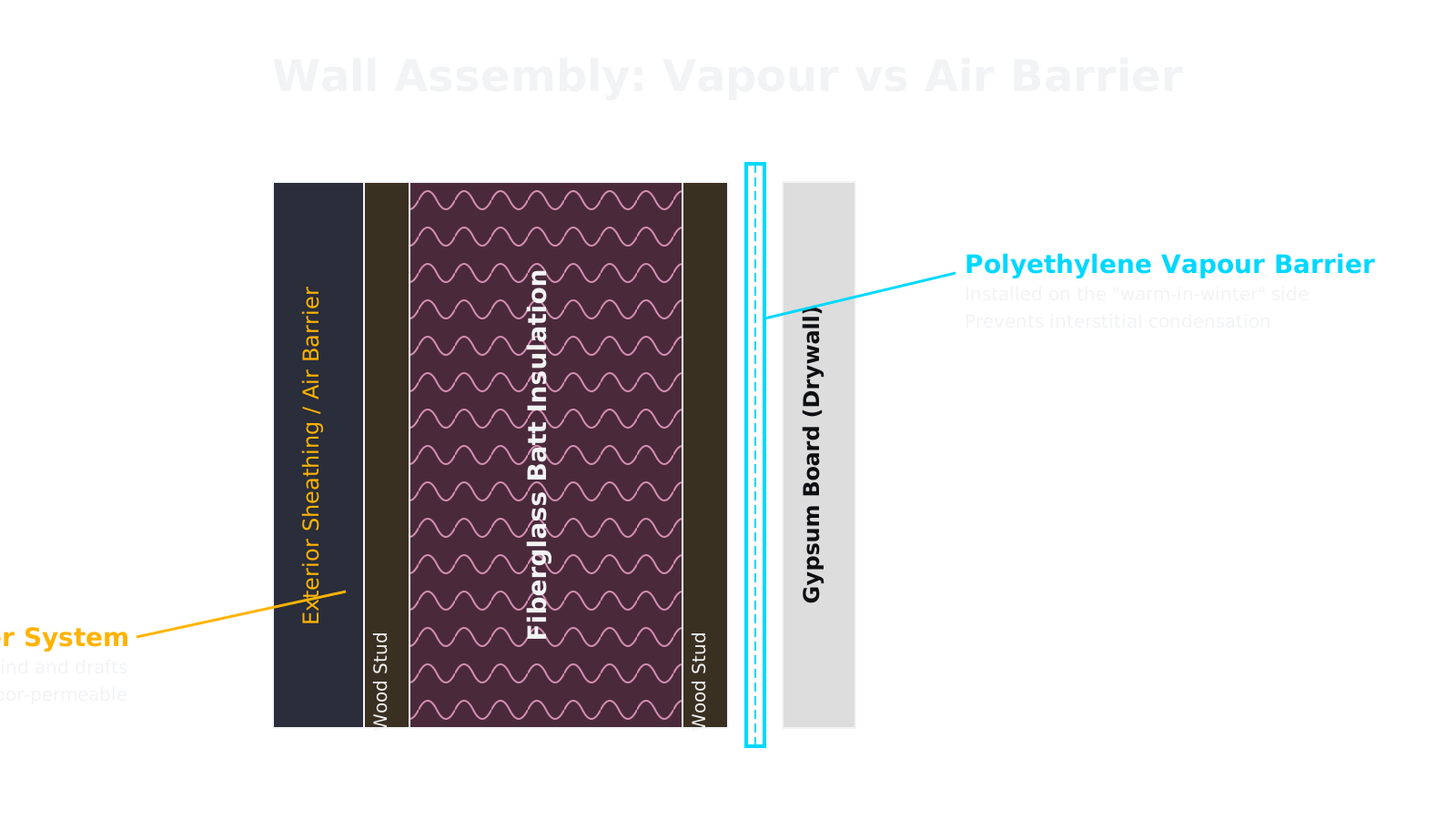
These two get treated as the same product doing the same job, partly because one sheet of poly can serve as both. They solve different problems, and the one people worry about less is the one that causes more damage.
Two ways water gets into a wall#
Vapour diffusion is water vapour working its way through a solid material, driven by a difference in vapour pressure. It is slow. Over a whole heating season it moves a modest amount of water.
Air leakage is warm indoor air carrying its moisture through a gap and depositing it when it hits something cold. A single hole around a light fixture or a poorly sealed top plate can move more water into an assembly in a season than diffusion does through the entire wall.
That difference in scale is the practical point. A wall with a perfect vapour barrier and a leaky air barrier will get wet. A wall with a good air barrier and a mediocre vapour retarder usually does not.
What each layer needs to work#
| Vapour barrier | Air barrier | |
|---|---|---|
| Job | Slow diffusion through materials | Stop air movement through gaps |
| Must be | Low permeance | Continuous, and sealed at every joint |
| Small holes | Tolerable | The entire problem |
| Where it goes | Warm side in a cold climate | Anywhere, as long as it is continuous |
| Typical materials | Polyethylene, foil facing, some paints | Sheathing membranes, taped sheathing, sealed poly, spray foam |
| How it fails | Installed on the wrong side | Interrupted at a penetration or a transition |
Which side it goes on#
In a heating-dominated climate the vapour barrier goes toward the warm side, because that is the direction vapour is being driven for most of the year. This is why poly behind the drywall is the familiar detail across most of Canada.
It stops being straightforward when the assembly changes. Add exterior insulation and you move where the assembly gets cold, which changes where condensation would form. Air condition heavily in summer and the drive reverses for part of the year. Below grade, the concrete itself is a moisture source and a wall detailed like an above-grade wall can trap water against the foundation.
The rim joist deserves its own paragraph#
The band of framing at the floor edge is where the wall above meets the foundation below, and it is the hardest place in the house to keep continuous. It is cold, it is hard to reach, it has joists running into it, and it usually gets whatever insulation was left over.
It is also where a lot of moisture problems start. Warm indoor air leaks into that cavity, hits cold rim board, and condenses. Fibreglass batts stuffed into the space do nothing to stop the air, so the batt stays warm on one side and the condensation forms behind it where nobody sees it until the joist ends are damp.
The reliable fix is an air-impermeable insulation applied directly to the rim board so there is no gap for air to reach the cold surface, or a carefully air-sealed rigid board cut to fit and sealed at every edge. Either way the sealing is the part doing the work.
Common questions#
- Can one material do both jobs?
- Yes. Sealed polyethylene is a vapour barrier and, if it is genuinely continuous and sealed at every edge and penetration, an air barrier as well. The second condition is the one that usually is not met.
- Do I need poly in a basement?
- Below grade is different enough that the above-grade answer does not transfer. Concrete holds and releases moisture, and an interior assembly detailed the usual way can trap it. Worth designing rather than defaulting.
- Does the house need to breathe?
- Not through its walls. That phrase describes air leakage, which you do not want. What a house needs is controlled ventilation, which means bringing in outdoor air deliberately through a fan or an HRV rather than accidentally through gaps.
- What is a smart vapour retarder?
- A membrane whose permeance changes with humidity. It resists diffusion in winter and opens up to let the assembly dry inward in summer. It is a way to get drying in both directions without giving up winter performance.
- How do I know if my air barrier works?
- A blower door test. It is the only way to get a number rather than an opinion, and it is far more useful before drywall, when the leaks are still reachable.
Looking for the number?
These pages state the requirement and name the document it comes from.
Related notes
Ask your own code question
Canadian Codes answers questions like this one from national, provincial, territorial, and municipal sources, and cites the document, section, and page so you can check it yourself.
Try it free →