

Where Carbon Monoxide Alarms Go
August 6, 2026 · 5 min read · Reviewed September 2026
Applies to Homes with a fuel-burning appliance or an attached garage, across Canada. CO alarm rules sit in the building code, the fire code, and sometimes a separate provincial statute. All three are local.
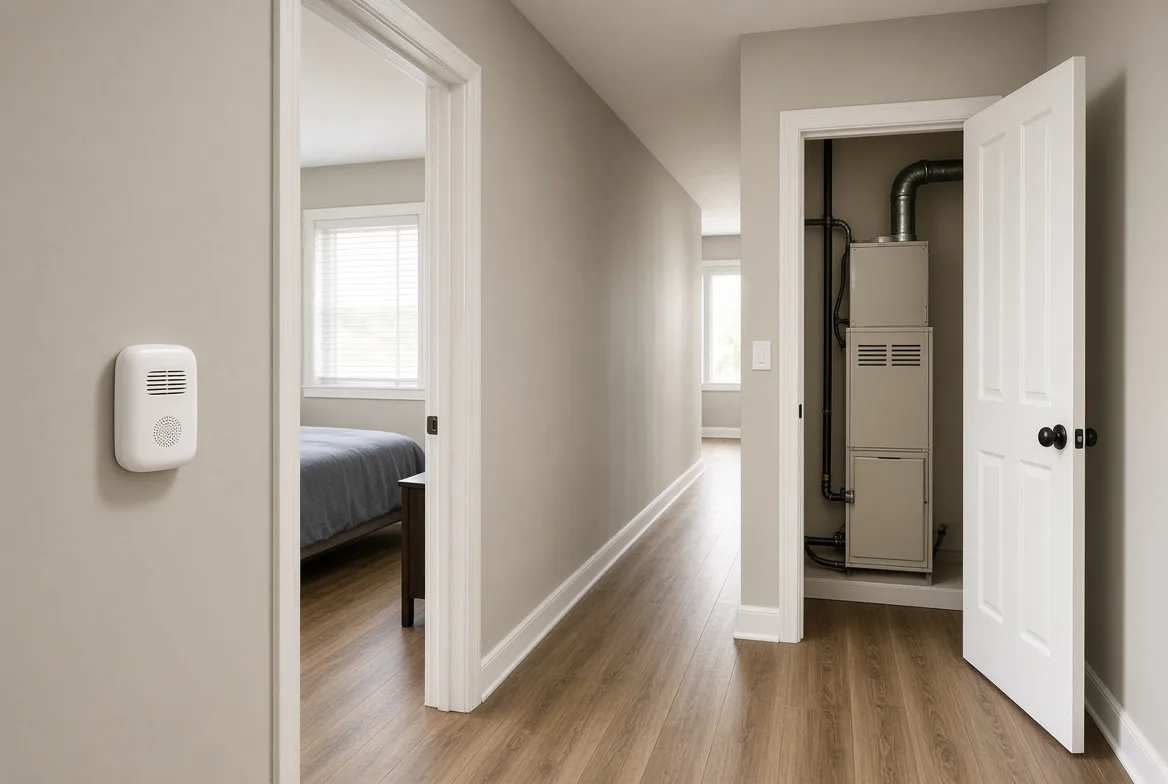
Smoke alarms and CO alarms get installed on the same afternoon, by the same person, out of the same shopping trip. They are treated as one job. They are not one job.
A house can be fully compliant on smoke alarms and have no CO coverage at all. Nothing about the smoke alarm layout would tell you that.
CO does not behave like smoke#
Smoke is hot. It rises, collects against the ceiling, and spreads out from there. That is why smoke alarms go high and why the middle of a ceiling is a good spot for one.
Carbon monoxide is close to the same density as air. It goes wherever the air in your house is going. It does not pool at the ceiling waiting for an alarm to find it, so height matters far less than it does for smoke.
What matters instead is being near the people who are asleep. CO poisoning kills people in their beds who never wake up. That is the failure the requirement is written around, which is why CO rules are organised by sleeping area rather than by storey and hallway.
What makes an alarm required#
| Trigger | Examples | Why it gets missed |
|---|---|---|
| A fuel-burning appliance | Gas or oil furnace, gas water heater, gas range, fireplace, wood stove, gas dryer | People think of the furnace and forget the water heater or the range |
| An attached garage | Any garage sharing a wall or ceiling with living space | The garage is the trigger even in an all-electric house |
| A shared wall with either | Row houses, duplexes, a suite over a garage | The source is not in your unit, so nobody thinks about it |
| Adding one later | A gas fireplace or range installed during a renovation | The renovation creates a requirement the house did not have before |
Where to put them#
The shape of the rule is consistent across the country even where the specifics are not. Cover the sleeping areas, and cover the source. What varies is whether an alarm is required inside each bedroom or only outside them, and whether every storey needs one.
Start with the sleeping areas
An alarm in the hallway serving the bedrooms is the baseline everywhere. Bedrooms on more than one level, or in separate wings, each need their own.
Cover the level with the appliance
A furnace or water heater in the basement means an alarm down there, even though nobody sleeps in the basement.
Treat the garage as a source
Put one in the living space next to an attached garage. Usually that is the room or hallway sharing the wall, or the room above it.
Read the instructions for the rest
Distance from the appliance, distance from vents and windows, and mounting height are all in the manufacturer’s instructions, and those instructions are enforceable. An alarm too close to a furnace nuisance-trips. One near a window misses.
Find out whether they have to be interconnected
In new construction and in suites, alarms usually have to sound together. That is a wiring decision made at rough-in, not a shopping decision made later.
One habit worth breaking: do not put a CO alarm on the ceiling out of reflex. Because CO does not layer up there, manufacturers differ on where their unit belongs, and some specify a wall at a particular height. The right answer is on the box, and the box governs. This is the one place where copying your smoke alarm approach gives you a worse result.
Combination units#
A combined smoke and CO alarm gives you a single device to mount and a single set of batteries to change. For most houses that is a reasonable trade. The catch is that both sensors have to live in the same spot, and the best spot for each is not always the same one.
| Separate units | Combination unit | |
|---|---|---|
| Placement | Each sensor goes where it works best | One location has to suit both |
| Replacement | Replace each when it expires | The whole unit goes when either sensor does |
| End of life | Two dates to track | One date, simpler to manage |
| Nuisance alarms | Move one without moving the other | Moving it moves both |
Either way, they expire. Sensors degrade whether or not the alarm has ever gone off, and there is a manufacture date and an end-of-life date printed on the housing. A ten-year-old alarm that chirps when you press test is telling you the horn works. It is not telling you the sensor still detects anything.
Common questions#
- My house is all electric. Do I need one?
- If there is an attached garage, almost certainly. If there is no attached garage and nothing that burns fuel, including a gas fireplace, a wood stove or a gas range, then often no. Check with your municipality, because some provinces legislate this separately from the building code.
- Does a plug-in alarm count?
- For an existing house being brought up to standard, usually yes. New construction and suites generally need hardwired, interconnected units instead. The two situations are governed differently.
- Why does mine go off when nothing is wrong?
- Usually placement, or age. Too close to a furnace, a water heater or the garage door will do it, and so will a sensor at the end of its life. Worth diagnosing rather than silencing, because an alarm people find annoying is an alarm someone eventually unplugs.
- Do I need a permit to add one?
- Not for a plug-in or battery unit. Hardwiring and interconnecting is electrical work, and whether that needs a permit depends on where you are and how much other work is going on.
Looking for the number?
These pages state the requirement and name the document it comes from.
Related notes
Ask your own code question
Canadian Codes answers questions like this one from national, provincial, territorial, and municipal sources, and cites the document, section, and page so you can check it yourself.
Try it free →